
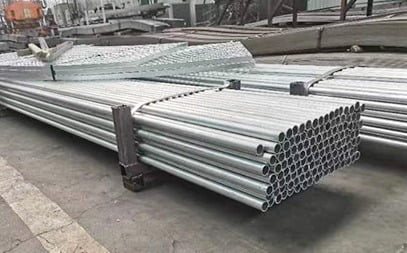
Industrial Handrailing Systems for Safe Access
Engineered handrails for boiler platforms, steel walkways and industrial structures – designed to meet international safety standards and B2B project requirements.
Handrailing Questions Your B2B Clients Are Searching For
We organize the most frequently asked technical and purchasing questions about industrial handrailing – and give clear, engineer-level answers on one page.
Basics
What is industrial handrailing?
Standards
Height, load, safety compliance
Materials & Coating
Carbon steel, stainless, HDG
Design Options
Modular, welded, bolt-on
Installation
On-site fixing & retrofits
Applications
Boiler, WHR, platforms
FAQ
Common buyer questions
Get a Quote
Send us your platform drawings
Scroll down to see detailed answers for each topic
What Is Industrial Handrailing for Platforms & Walkways?
In industrial plants, “handrailing” usually refers to steel guardrails installed along platforms, walkways, staircases and equipment areas, preventing falls from height and ensuring safe access for operators and maintenance teams.
Key B2B Question: “What information do you need to design handrailing for our platform?”
For most EPC, boiler OEM and end-user projects, we ask for:
- • Platform height above floor or ground.
- • Applicable safety standard (OSHA, EN ISO, local code, client specification).
- • Intended use: boiler platform, heat exchanger gallery, pipe rack, access walkway, etc.
- • Indoor / outdoor, corrosive environment, coastal area or not.
- • Required handrail height, toe board requirement, and gate / opening positions.
Buyer Question 1: “What is the standard height of industrial handrails?”
Common design ranges from 1000–1200 mm (top rail height from finished floor). Exact height is based on the standard required by your market or end user.
Buyer Question 2: “Do you supply complete handrail kits or only components?”
We can supply complete handrailing assemblies (posts, rails, kick plates, connectors, fasteners) according to your drawings, or customized sections matched to your steel structures.
What Standards Should Industrial Handrails Comply With?
Different countries and industries follow different safety standards. We design handrailing systems to match your specified code and project requirements.
Typical Handrailing Standards and Design Points
| Standard / Code | Typical Height | Typical Load | Notes |
|---|---|---|---|
| OSHA / ANSI (North America) | Around 1067–1120 mm | Point or line loads defined by code | Common for US industrial plants and boiler houses. |
| EN ISO 14122, EN 1991 (Europe) | Around 1100 mm | ≈ 0.3–1.0 kN/m or higher, depending on application | Used for machinery access and industrial walkways. |
| Project / Owner Specification | 1000–1200 mm | Often 1.0–1.5 kN/m line load | For power plants, petrochemical and heavy industry projects. |
Engineering Tip: When sending inquiries, please attach your design standard or owner requirements. We will calculate post spacing, rail sizes and connection details accordingly.
Buyer Question 3: “Can you design handrails based on our local safety code?”
Yes. We usually design according to the standard specified in your RFQ or drawings. If no code is given, we will propose commonly used parameters and leave final approval to your engineering team.
Buyer Question 4: “How do you control quality of welding and dimensions?”
Dimensions and welds are checked against approved drawings. We can provide welding procedures, welder qualification records, inspection reports and photos for your QC and third-party inspection.
What Material & Coating for Industrial Handrailing?
For long-term safety around boilers and industrial equipment, material selection and surface treatment are as important as structural design.
Typical Material & Coating Options
| Environment | Material | Coating | Typical Application |
|---|---|---|---|
| Indoor, non-corrosive | Carbon steel (e.g. Q235 / A36) | Primer + industrial topcoat | Boiler rooms, galleries, workshops. |
| Outdoor, standard climate | Carbon steel | Hot-dip galvanizing (HDG) | Platforms, roofs, external walkways. |
| Coastal or corrosive area | Carbon steel or stainless steel | HDG + paint, or pickled & passivated SS | Petrochemical, desalination, marine. |
| Hygienic / clean environment | Stainless steel (e.g. 304/316) | Polished / brushed finish | Food, pharma, special industries. |
Selection Tip: For most power and boiler platforms, hot-dip galvanized carbon steel is a cost-effective and durable choice. Stainless steel is recommended when corrosion resistance or appearance is critical.
Buyer Question 5: “Can you match the color to our plant standard?”
Yes. If painting is required, we can follow your RAL color or paint system specification. For galvanized handrails, top coating can be added for color coding or branding.
Buyer Question 6: “How thick is your galvanizing layer?”
We work with standard hot-dip galvanizing processes. Typical zinc layer thickness can be shared upon request, and we can provide galvanizing certificates from our partner plants.
Modular, Welded, or Bolt-On – Which Handrail Design to Choose?
Different projects need different handrailing concepts. We can work with fully welded panels, modular systems, or bolt-on posts and rails, depending on your site and logistics.
Welded Handrail Panels
Top rail, mid rail and posts welded into complete frames.
- • Good rigidity and appearance.
- • Fast installation on site (bolt to base plates).
- • Suitable when shipping size is acceptable.
Ideal for standard platform modules in power and boiler plants.
Modular / Knock-Down Systems
Posts, rails and fittings supplied separately, assembled on site.
- • Better container loading & shipping efficiency.
- • Flexible to adjust on site around equipment.
- • Good for export projects with long routes.
Recommended when there are many irregular platforms and walkways.
Bolt-On to Existing Structures
Handrailing is designed for retrofitting onto your existing steelwork or concrete.
- • Customized base plates or brackets.
- • Useful for upgrades and safety improvements.
- • Minimal modification to existing structures.
Often used in retrofit safety upgrade projects for older plants.
Buyer Question 7: “What is the best way to send you our handrail requirements?”
The most efficient way is to send us your steel platform drawings (DWG/PDF), handrail layout, and applicable safety standard. Our engineering team will mark up handrail positions and prepare a complete bill of material.
Upload Drawing & Request ProposalInstallation, Packing & Maintenance – What Should You Expect?
For B2B buyers, installation efficiency, packing method and maintenance expectation are part of the purchasing decision.
Installation
- • Base plates drilled to match your bolt patterns.
- • Welded or bolted connection between posts and rails.
- • Simple on-site tools: wrench, drill, welding (if needed).
- • We can supply basic installation guidance and layout drawings.
Packing & Shipping
- • Bundled handrail panels, labeled for quick identification.
- • Posts and accessories packed in steel frames or crates.
- • Optimized for container loading (export) or truck transport.
Maintenance
- • Periodic visual inspection of corrosion and damage.
- • Touch-up painting for minor damages on coated surfaces.
- • Replacement sections available if heavily damaged.
Typical Handrailing Applications in Industrial Plants
We focus on handrailing for heavy-duty industrial environments, not residential or decorative use.
Boiler Platforms
Steam, hot water and biomass boiler plants.
Waste Heat & WHR Units
HRSG, economizer and heat exchanger platforms.
Power & CHP Plants
Turbine halls, pipe racks, auxiliary buildings.
Petrochemical & Refinery
Columns, vessels, pipe bridges and access ways.
Cement & Steel Plants
Kiln, preheater and process galleries.
Maintenance Platforms
Access around blowers, pumps and equipment.
Walkways & Roof Access
On roofs, mezzanines and long corridors.
Retrofit Safety Upgrades
For existing plants to improve fall protection.
Handrailing FAQ – High-Intent Buyer Questions
These are the questions we hear most often from project managers, engineers and purchasers.
Q1: What information should I include when sending a handrailing inquiry?
Please share platform drawings, required safety standard, handrail height, material & coating preference, estimated quantity (meters or sets), project location and required delivery time. This allows us to prepare a clear proposal in one step.
Q2: Can you match the handrail design used in our existing plant?
Yes. If you provide photos and key dimensions, or drawings from your existing plant, we can design compatible handrailing so that new and old areas look consistent.
Q3: Do you provide calculation reports for the handrail strength?
For critical projects, we can cooperate with your engineering team to provide basic strength checks based on the given load requirements and section sizes. Detailed structural calculation reports can also be arranged according to your specification.
Q4: How do you ensure traceability for materials and coatings?
For project orders, we can keep records for steel material certificates, galvanizing or painting reports and packing lists per batch, so that your QA/QC team can trace each shipment to its documentation.
Request a Handrailing Proposal for Your Project
Fill in your basic information and requirements. We will review and reply with a tailored B2B solution for your platforms and walkways.