
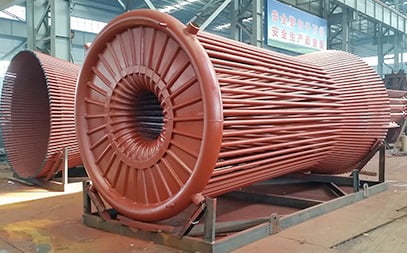
Industrial Boiler Cyclone Separator
High-efficiency flue gas dust removal for reliable boiler operation, lower emissions, and protection of downstream equipment.
Everything About Cyclone Separators
Navigate through our cyclone separator guide. Click any card below to jump directly to that section.
Product Basics
What it is & how it works
Types & Selection
Single, multi-cyclone & systems
Materials & Standards
Wear resistance & certifications
Manufacturing Process
From plate to finished cyclone
Applications
Industries & typical systems
Investment Value
Why cyclone separators matter
FAQ
Common questions answered
Get Quote
Contact our experts now
Scroll down to explore each section in detail
What is a Cyclone Separator for Boilers?
A cyclone separator is an inertial dust collector that uses centrifugal force to remove solid particles from flue gas, protecting downstream equipment such as economizers, air preheaters, and bag filters.
Key Performance Concept
Optimized Geometry
with Acceptable Pressure Drop
The right balance between cyclone diameter, inlet design, and gas velocity helps achieve high dust removal efficiency while keeping energy consumption under control.
How It Works
Dusty Gas Enters Tangentially
Boiler flue gas with dust enters the cyclone inlet at high velocity.
Spiral Flow & Centrifugal Force
Gas rotates downward, forcing heavier particles toward the wall.
Dust Collection
Particles slide down along the cone and fall into the hopper.
Cleaned Gas Discharge
Relatively clean flue gas moves upward through the vortex finder and exits to the next equipment.
Protect Downstream Equipment
Reduces dust loading on economizers, air preheaters, and bag filters.
Improve Emission Performance
Pre-separation of coarse dust helps your overall system meet environmental limits.
Simple & Robust
No moving parts, low maintenance, long service life.
Cost-Effective Solution
Low investment & operating cost compared with many other dust collectors.
Need a Cyclone Separator for Your Boiler Line?
Share your flue gas volume, dust loading, and temperature – we’ll design a cyclone matched to your system.
Cyclone Separator Types & Configuration
Select the right cyclone arrangement based on gas flow, dust characteristics, space constraints, and emission targets.
| Feature | Single Large Cyclone | Multi-Cyclone Array | System with Secondary Collector |
|---|---|---|---|
| Typical Application | Smaller boilers, coarse dust removal | Medium to large boilers, higher efficiency | Pre-collector before bag filter / ESP |
| Collection Efficiency | Medium | Medium–High | High overall (system level) |
| Footprint | Larger diameter, higher unit | Modular, compact layout | Depends on downstream collector |
| Complexity | Simple | More components, more nozzles | System integration required |
| Best Use Case | Basic dust control, low cost | Enhanced dust removal with limited space | High-performance emission control line |
Single Large Cyclone
✓ Advantages
- → Simple layout and ducting.
- → Easy inspection and maintenance.
- → Lower initial investment.
- → Suitable as primary dust control for small capacities.
▸ Best Applications
- • Small industrial boilers.
- • Coarse particles / low dust loading.
- • Where moderate efficiency is acceptable.
Multi-Cyclone Array
Multiple small-diameter cyclones in one housing for higher efficiency.
✓ Advantages
- → Higher collection efficiency for fine particles.
- → Compact modular structure.
- → Gas flow can be evenly distributed.
- → Easy to add or remove cyclone elements.
✗ Considerations
- • More welding and assembly work.
- • Slightly higher initial cost.
- • Requires careful design to avoid plugging.
▸ Best Applications
- • Medium and large industrial boilers.
- • Biomass and waste-to-energy lines.
- • Where better dust removal is required before bag filters or ESP.
Cyclone + Bag Filter / ESP System
In many modern boiler houses, cyclone separators are used as pre-collectors to reduce dust loading on high-efficiency bag filters or electrostatic precipitators. This combination improves system reliability, reduces wear on filter bags or ESP plates, and lowers overall operating cost.
Key Benefit:
Significant reduction of coarse dust before fine filtration, protecting downstream equipment.
Common Use:
Coal-fired, biomass, and waste-to-energy boilers with strict emission requirements.
Not Sure Which Cyclone Layout to Choose?
Our engineering team will help you select the optimal cyclone configuration based on flue gas parameters and space conditions.
Materials, Linings & Standards
High-temperature steels and wear-resistant linings designed for abrasive dust and continuous service in boiler flue gas conditions.
Certifications & Standards
-scaled.jpg)
Typical Material & Lining Options
| Operating Condition | Shell Material | Internal Lining | Typical Use |
|---|---|---|---|
| Standard temperature, moderate dust | Carbon steel (Q235 / A36) | No lining or basic anti-wear paint | Small industrial boilers |
| Higher temperature & dust loading | Boiler steel (Q345R / SA-516) | Local wear plates at impact zones | Coal-fired & biomass boilers |
| Abrasive dust, long service life | Low alloy wear-resistant steel | Replaceable wear liners / ceramic tiles | Cement, steel & WtE industries |
| Very high temperature | Heat-resistant steel | Refractory lining in selected areas | Hot flue gas or furnace outlets |
Design Focus: For cyclone separators, correct material selection at high wear zones (inlet, cone, hopper) is critical. We provide layout optimization plus wear protection solutions to match your dust abrasiveness and expected service life.
Precision Fabrication for High-Dust, High-Temperature Service
From plate cutting to final assembly, every cyclone is built according to drawing and inspected at key stages.
Our Cyclone Manufacturing Process
Design & Engineering
Plate Cutting & Rolling
Welding & Assembly
Lining & Surface Treatment
Inspection & Shipment
Key Quality Control Items
- ✓ Plate material inspection and traceability.
- ✓ Dimensional check for cylinder, cone & inlet.
- ✓ Weld quality inspection (visual, NDT where required).
- ✓ Lining installation quality & thickness check.
Documents Provided
- ✓ Material certificates for main plates.
- ✓ Welding procedure & welder qualification records.
- ✓ Dimension & visual inspection reports.
- ✓ Factory paint & lining reports upon request.
Integrated fabrication and quality control help ensure reliable operation from day one.
Industries & Boiler Systems We Serve
Cyclone separators tailored for different fuels, dust characteristics, and boiler configurations around the world.
Coal-Fired Power
Utility & industrial coal boilers.
Biomass Power
Bagasse, wood chips, agri-waste.
Waste-to-Energy
Municipal solid waste & RDF boilers.
Cement & Lime
Kiln & clinker cooler dust removal.
Steel & Metallurgy
High-dust flue gas applications.
Chemical & Refinery
Process heaters and boilers.
CHP & Industrial
Cogeneration & industrial steam systems.
Retrofit Projects
Upgrades to existing boiler houses.
Why Invest in a Quality Cyclone Separator?
A well-designed cyclone separator is a small part of your flue gas system – but it has a big impact on reliability, maintenance cost, and emission performance.
Protect the Heart of Your Boiler Line
-
✓
Downstream Protection: Reduce wear on economizers, air preheaters, ducts and stacks by capturing coarse dust early.
-
✓
Stable Emission System: Lower dust load into bag filters or ESP means longer bag life and more stable performance.
-
✓
Less Unplanned Shutdowns: Minimize plugging and abrasion failures, reducing unexpected outages and repair work.
Lower Lifecycle Cost & Easier Operation
-
✓
No Moving Parts: Cyclones rely on geometry, not mechanics, which keeps maintenance simple.
-
✓
Optimized Pressure Drop: Our designs aim at the right balance between separation efficiency and fan power consumption.
-
✓
Long Service Life: With proper wear protection, cyclone separators can run for many years with minimal intervention.
Cyclone Separator FAQ
A few quick answers to the most common questions we receive from boiler owners and EPC contractors.
1. What data do you need to design a cyclone separator?
Typically we need: boiler capacity, flue gas volume and temperature, dust concentration, dust characteristics (density, particle size if available), fuel type, layout constraints, and local emission requirements. The more information you share, the more accurate our design will be.
2. Can you supply cyclone separators as part of a complete boiler system?
Yes. We can design the cyclone separator as a standalone product or integrated with economizers, air preheaters, ducts, and dust collection systems, according to your process layout.
3. Do you provide support for retrofit projects?
We often work on retrofit projects where space is limited and existing ducts must be kept. Our team can adapt cyclone geometry and support structures to fit into your current system with minimal modification.
4. How will the cyclone affect my system pressure drop?
Pressure drop depends on design details and gas velocity. During engineering, we calculate approximate pressure loss and consider your existing fan capacity, then optimize cyclone sizing to keep operation safe and economical.
Request a Cyclone Separator Proposal
Leave your project details here – our engineering and sales team will review your working conditions and send a tailored solution.